 East African Mining News Unearthing Mining Opportunities in East Africa


Related Articles

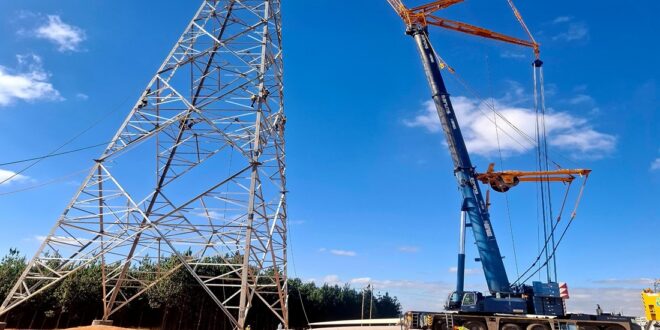
The scale of Tanzania’s industrial ambitions is beginning to reshape the equipment needed to build them. As mining developments expand alongside power transmission, renewable energy, oil and gas and major infrastructure projects, Sarens is strengthening its local heavy-lifting capability with a new 260 tonne all-terrain crane. The XCMG XCA260H joins a recently acquired 350 tonne crane, giving Sarens greater capacity to handle large components and structures at projects where conventional lifting equipment may no longer be sufficient.
The company says the investment is aimed at supporting Tanzania’s increasingly demanding industrial projects, many of which are located in remote areas and operate against tight construction schedules. The move comes as mining remains a major driver of demand for heavy equipment, while Tanzania is also investing in power transmission, solar generation and oil and gas infrastructure. For contractors, the ability to mobilise high-capacity lifting equipment close to project sites can have a direct bearing on construction schedules, particularly where large plant components must be installed in difficult or remote locations.
Sarens noted that local lifting capacity has historically been concentrated around equipment of approximately 150 tonnes, with relatively few machines exceeding 200 tonnes. The addition of the 260 tonne XCA260H therefore increases the range of heavy components that can be handled locally without relying as heavily on equipment mobilised from elsewhere. The new crane is part of a wider fleet expansion by Sarens across Southern Africa, supported by its strategic relationship with Chinese manufacturer XCMG. The broader programme includes cranes ranging from all-terrain units to the 1,300 tonne XLC18000M crawler crane, with applications spanning mining, energy, petrochemicals, infrastructure and renewable energy.
In Tanzania, the immediate focus is on equipment capable of combining lifting capacity with mobility. The XCA260H is mounted on a five-axle all-terrain platform, with a 405 kW engine and road speed of up to 80 km/h. Its 80m telescopic main boom can be supplemented by a 20m luffing jib, allowing the crane to undertake lifting and installation work at significant heights. That combination is particularly relevant to projects where access and mobilisation can be as challenging as the lifting operation itself. Rather than being limited to a fixed industrial site, an all-terrain crane can be moved between project locations, providing greater flexibility as construction requirements change.
This capability can support the construction and expansion of processing plants, material-handling facilities and other mine infrastructure in Tanzania. In the power sector, larger cranes are increasingly required for grid infrastructure and generation projects, while oil and gas developments bring their own demands for specialised lifting and installation. Renewable energy is another emerging application. Sarens says its regional operations have already supported the assembly of wind towers in remote parts of Tanzania’s Iringa region, including structures reaching hub heights of 75m.
Sarens Tanzania’s Country Manager, Michael Dewart, said the expansion reflects a broader shift in the country’s industrial requirements. “We are going through a decisive phase in Tanzania’s industrial and economic development. The rapid expansion of mining activities, alongside heavy investment in power transmission lines, solar generation and oil&gas infrastructure, requires engineering solutions executed with high technical precision and strict adherence to safety standards. Because many of these complex lifting maneuvers take place in remote areas and demanding environments, access to high-capacity, rapidly deployable equipment and highly trained local teams is essential. Expanding our local fleet strengthens our capability to support Tanzania’s primary economic growth sectors,” said Dewart.
The investment also reflects a wider shift in the regional heavy-lifting market. Sarens has been expanding its Southern African fleet with new XCMG equipment as project developers demand greater lifting capacity, mobility and specialised engineering support. The company’s wider XCMG programme includes equipment designed for applications ranging from heavy industrial assembly and wind projects to mining, petrochemical facilities and civil infrastructure. The significance extends beyond the addition of another crane. As projects become larger and infrastructure networks more sophisticated, the availability of specialised equipment becomes part of the industrial ecosystem required to deliver them. The 260 tonne XCA260H gives Sarens greater room to operate within that ecosystem, while the addition of the 350 tonne unit expands its ability to tackle heavier assignments.

