East African Mining News Unearthing Mining Opportunities in East Africa


Related Articles
Saudi Arabia’s diversification push has reached East Africa’s skyline. Mabani Aljazeera Holding Group has agreed to acquire a 50%-less-one-share stake in Jabali Towers, a flagship mixed-use development inside Tatu City’s Special Economic Zone, its first-ever investment in Kenya and a signal that Gulf capital is moving well beyond its traditional energy and infrastructure comfort zone. The stake will be held through Mabani’s subsidiary, Swan Properties, with Africa-focused developer Rendeavour retaining majority ownership. Deal terms were not disclosed.
The transaction lands squarely within Saudi Arabia’s Vision 2030 diversification agenda, as Gulf investors increasingly look to African urban development, logistics, mining, renewable energy and industrial infrastructure for long-term returns. Jabali Towers, located in Kiambu County roughly 20 kilometres north of Nairobi, will comprise two residential towers of 25 and 36 storeys across approximately 88,000 square metres, with units, studio through three-bedroom, priced from 10.2 million Kenyan shillings ($78,200). More than 80% of units in the first tower are already sold, according to Tatu City, a demand signal that will matter to future Gulf entrants weighing similar bets.
China Road and Bridge Corporation (CRBC), the state-owned firm behind Nairobi’s Expressway has been appointed main contractor, adding another layer of cross-continental capital and construction expertise to the project. Residents will plug into infrastructure already built out at Tatu City, uninterrupted water supply, 99.7% electricity availability, more than 70 kilometres of paved roads, and over 100 kilometres of walking and cycling trails. “Jabali Towers will become the flagship real estate project in Africa,” said Abdullah AlMalki, Chairman of Mabani Aljazeera Holding Group, calling the deal the start of a long-term Kenyan expansion. The Saudi Export-Import Bank, for its part, positioned the transaction as reinforcing the Kingdom’s push to raise the global profile of Saudi companies.
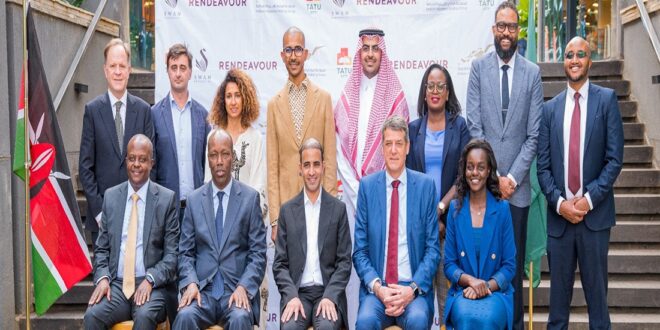
The deal fits a broader pattern of Saudi firms that have stepped up African investment across renewable energy, logistics, mining, tourism, agriculture and real estate, while East African governments compete to attract Gulf capital to close infrastructure financing gaps and fund urbanisation. Kenya, with its strategic positioning, expanding middle class and steady demand for residential and commercial space, has positioned itself as one of the region’s top destinations for that capital. The signing ceremony drew a notably senior line-up such as Kenya Investment Authority CEO John Mwendwa, Cabinet Secretary for Investments, Trade and Industry Lee Kinyanjui, Mabani Chairman Abdullah AlMalki and Rendeavour Founder and CEO Stephen Jennings, underscoring how much weight Nairobi is putting behind deepening Saudi investment ties. Jennings signalled this is only the opening move: Swan Properties, he said, is expected to be the first of several Saudi investors backing future Tatu City developments.
The investment adds to the scale of one of Africa’s largest privately developed mixed-use urban projects. Spanning more than 5,000 acres, Tatu City now hosts more than 110 businesses, schools educating over 6,000 students and roughly 3,500 mixed-income homes completed or under construction, drawing around 35,000 daily visitors with a resident population growing more than 40% annually. Rendeavour’s African property portfolio was independently valued at approximately $3 billion at the end of 2024 and the company recently became the African Continental Free Trade Area (AfCFTA) Secretariat’s first private-sector partner, reinforcing ambitions to position Tatu City as a regional business and investment hub.
Upcoming milestones include the planned opening of the Tatu Nature Reserve later this year and Wellington College International Kenya, due to welcome its first students in 2028. For capital markets watching Gulf-Africa flows, the message is unambiguous, Saudi money is no longer content to stay upstream in oil and gas, it’s now buying into the continent’s urban growth story directly.