East African Mining News Unearthing Mining Opportunities in East Africa


Related Articles
After years of cautious adoption, mining electrification is entering a decisive acceleration phase and ABB believes the industry has crossed a critical maturity threshold. With validated deployments and significantly reduced risk, the company expects electrified ore handling to grow exponentially over the next five years far more aggressively than in the past decade.ABB’s strategy goes beyond supplying motors, switchgear or trucks. Through its e-mine™ framework, the company views the mine as one integrated electrical and digital ecosystem.
“To date, the industry has been quite restrained especially in electrified ore handling and materials movement. Operators were waiting for the technology to prove itself. Over the last two years, that’s happened. We now have very strong references in underground battery-electric trolley trucks. The technology is established. It’s running. Clients can see it working,” explained Erik Pretorius, Global Lead: Large and Strategic Mining Projects and Initiatives at ABB’s Process Industries Division. He added that the level of maturity now satisfies client needs, with far less risk than three to five years ago. Traditionally, the industry has operated with disparate control systems. ABB’s e-mine philosophy starts with early engagement and removes the silos between mine, plant and auxiliary services. “We don’t distinguish between mine, plant and auxiliary services,we see one integrated operation,” noted Pretorius.
From 220kV infrastructure down to underground charging networks, ABB designs overarching power systems that enable transparent power flow, improved efficiency and long-term scalability. The advantage is holistic asset management, an area often fragmented in conventional mining environments.Pretorius explained, “An integrated power flow allows for future-proofing and creates the capacity to eventually move into an all-electric mine.” Standardisation remains central to that future. Interfaces between different OEMs continue to present industry-wide challenges and ABB advocates for common protocols and digital frameworks to ensure compatibility and long-term stability.
Electrification is particularly complex in power-constrained regions including parts of Africa, where miners are supplementing grid supply with renewables and co-generation. “Clients are striving to become more self-sufficient. But managing grid supply, renewables and co-generation introduces complexity,” said Pretorius. ABB’s digital energy management solutions are designed to optimise multiple power sources, delivering the most cost-effective electricity mix while maintaining operational stability. The convergence of electric and digital capability is now non-negotiable. “We don’t talk about electric mines only anymore. Electric mine and digital mine must be part of the same conversation,” stated Pretorius.
While greenfield projects allow electrification to be embedded from day one, brownfield operations require a more strategic transition. “You cannot add electrical loads to an existing operation and expect the upstream network to support that,” said Pretorius. ABB’s approach begins with improving the efficiency of existing power flows. By reducing losses and unlocking spare capacity, mines can create the headroom required for electric fleets and charging infrastructure. The resulting cost savings can help finance the electrification journey. He added, “Clients are willing to go all-electric but it has to make business sense. Improving efficiency first helps fund the transition.”
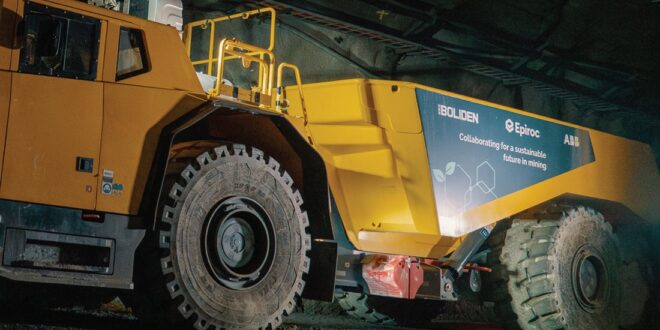
Among the most promising developments is the electrification of underground ore handling through battery-electric trolley trucks. “We’ve deployed a world-first battery-electric trolley truck in Europe. More clients are latching onto underground trolley systems and the benefits compared to static charging. However, electrification alone is not sufficient. Digital platforms — including operations and fleet management systems are critical to unlocking full value. If electrification isn’t coupled with digital solutions, you won’t derive the full benefit. Power management, fleet management and multi-source management must work together,” explained Pretorius.
ABB emphasises early engagement and integrated project teams to ensure smoother implementation. “We refer to it as an integrated project team, consultant, OEM and client working together from design through to deployment. Rather than short-term training after installation, operational teams are involved from the outset, enabling continuous skills transfer throughout the project lifecycle. You don’t train people for a week or two and expect them to run an installation like this. It must happen throughout the project,” elaborated Pretorius.
ABB’s outlook is clear: the industry is moving from pilot projects to scaled electrification. Underground trolley systems, renewable integration and digital optimisation are converging into a new operating model. “The future isn’t just electric. It’s electric and digital together,” concluded Pretorius. With technology validated, risk reduced and integrated power architectures maturing, ABB sees mining electrification shifting firmly into mainstream deployment over the next five years.