East African Mining News Unearthing Mining Opportunities in East Africa


Related Articles
With Uganda’s next phase of economic growth set to depend on doing more with what it already produces, the government is seeking to turn its $69 billion economy into the foundation for a far more ambitious $500 billion future.
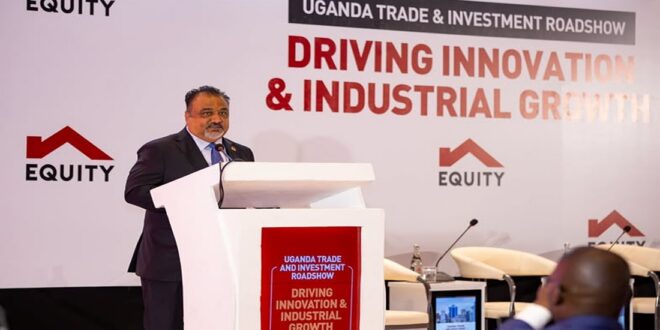
The economy has expanded from about $50 billion, narrowing the distance to the target and shifting the focus towards investment in agro-processing, mineral processing, tourism, manufacturing and technology. Trade and Industry Minister Sanja Tanna said the country’s progress means the original tenfold growth ambition is now a sevenfold challenge. Speaking at the ongoing Equity Uganda Trade and Investment Roadshow 2026, Tanna said the government had initially set the target under National Development Plan IV, seeking to grow the economy from about $50 billion to $500 billion. “We are now sitting at around $69 billion. That means it’s no longer a tenfold growth strategy. We are left with only sevenfold. It’s achievable, it’s doable,” said Tanna.
The government’s next phase is centred on sectors capable of creating greater domestic value, with agro-processing, tourism, mining and mineral processing, and science, technology and innovation identified as key areas for investment. Tanna said Uganda’s young population, natural resources, strategic location and access to regional markets give the country important advantages, but said these assets would have limited economic impact without investment in productive capacity. He said, “Those alone do not create prosperity. We must transform our productive capacity by increasing investments in manufacturing, value addition and innovation.”
Agriculture provides one of the clearest opportunities to capture more value locally. Tanna pointed to coffee, with more than 90% of Uganda’s production exported without significant processing. This leaves value from processing, packaging and branding to be captured elsewhere, limiting the economic benefits generated within Uganda. The government is therefore seeking investors willing to move further along agricultural value chains, creating additional export earnings, jobs and industrial capacity. The same approach is expected to apply across other commodities where Uganda already has established production.
Mineral processing presents another avenue for industrial expansion. Uganda has deposits of copper, cobalt, iron ore and phosphates, yet much of this potential remains underdeveloped. Tanna singled out phosphate processing as an opportunity, particularly as Africa continues to rely heavily on imported fertilisers despite its mineral resource base. Technology and services are also becoming part of the growth equation. Uganda now graduates nearly 350,000 students annually from more than 55 public and private universities, compared with about 1,000 graduates from one public university in 1986, Tanna said.
The government wants to translate that expanding skills base into opportunities in software development, data centres, call centres and business process outsourcing. Investment in a national fibre backbone is intended to support high-speed data services and strengthen Uganda’s position as a regional technology and services hub. Infrastructure will underpin that ambition. Tanna pointed to improvements in electricity generation, roads, manufacturing and aviation, as well as industrial parks and export promotion zones designed to attract investment targeting regional and international markets.
Uganda’s regional trade position adds another dimension to the investment proposition. Membership of the African Continental Free Trade Area, East African Community and COMESA gives companies operating in the country access to a continental market of about 1.5 billion people. Planned improvements to rail, air, road and lake transport are expected to further strengthen Uganda’s role as a regional production and trading hub. Tanna urged investors at the Equity roadshow to look beyond the domestic market and use Uganda as a gateway to wider African opportunities. “Uganda is ready for business,” concluded Tanna.