East African Mining News Unearthing Mining Opportunities in East Africa


Related Articles

When Kenyan President William Ruto stepped onto the vast grounds of the 700,000-barrel-per-day Dangote Petroleum Refinery in Lagos, Nigeria, fresh off his appearance at the United Nations General Assembly, he was expecting a major industrial facility. What he encountered, by his own account, was something far more transcendent, a high-tech industrial ecosystem operating at a scale rarely seen on the African continent.
Marveling at the seamless integration of heavy engineering and modern logistics, President Ruto described the Lagos installation as “a masterpiece of science, engineering, and art.” The visit was far more than a ceremonial tour; it served as a high-stakes blueprint for the future of East Africa’s energy security.
“Coming here and seeing it for myself, I can confirm that I have seen a masterpiece,” Ruto remarked, praising Dangote Group President Aliko Dangote. “To my brother Aliko, congratulations. I always knew Nigerians to be very brave people and go-getters, but I did not anticipate that it was at this scale.”
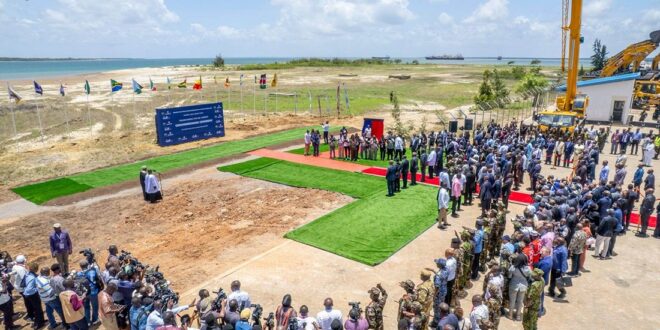
That scale is now heading east. The tour underscored Kenya’s firm commitment to partnering with the conglomerate on the proposed $17 billion East African Oil Refinery and Petrochemical Complex in Lamu. Far from being a distant vision, the groundbreaking ceremony for the greenfield facility is already prepared, backed by $450 million in engineering and consultancy contracts signed with Engineers India Limited (EIL).
Designed to match the flagship Lagos facility with a capacity of 700,000 barrels per day, the Lamu complex is envisioned as a game-changer for the entire East African region, aimed at slashing fuel import dependency, building technical capacity, and boosting industrial competitiveness across borders.
“This is not a Kenyan refinery; it is going to be a regional refinery,” President Ruto emphasized, pledging that his administration is moving swiftly to eliminate bureaucratic hurdles. “We are positioning our continent as an emerging growth centre. The Government of Kenya is 100 per cent behind this project. We have secured the required land and are working to ensure that we spend our time building rather than navigating administrative delays.”
For Dangote Group, the Lamu project represents a cornerstone of its Vision 2030 Strategy, an aggressive campaign to build a $100 billion African industrial enterprise. Supported by massive revenue momentum, with the group generating approximately $17 billion in the first half of 2026 and projecting a full-year record of $36 billion, the conglomerate is doubling down on African infrastructure.
“Between 2020 and 2025, the Group executed a capital expenditure programme of approximately $50 billion,” noted Aliyu Suleiman, Dangote Group’s Chief Strategy Officer. “Over the next five years, we intend to invest twice that amount as we accelerate our expansion across Africa. The East African refinery in Kenya is going to be a key component of our journey and our dream.”
With Dangote concurrently progressing plans to double its Lagos refining capacity to 1.4 million barrels per day, the partnership between Kenya and the Nigerian industrial giant marks a decisive shift toward intra-African investment, proving that the continent’s industrial renaissance is increasingly being built, financed, and engineered by Africa itself.