East African Mining News Unearthing Mining Opportunities in East Africa


Related Articles

African heads of state, commercial titans, and institutional investors assembled in Egypt’s coastal city of El-Alamein on Saturday for a high-stakes three-day summit aimed at restructuring the continent’s financial ecosystem. The inaugural Alamein Africa Forum brought together over 20 government leaders alongside regional bankers and development institutions to address a persistent challenge: mobilizing intra-continental capital to fund long-term growth and curb reliance on external financing.
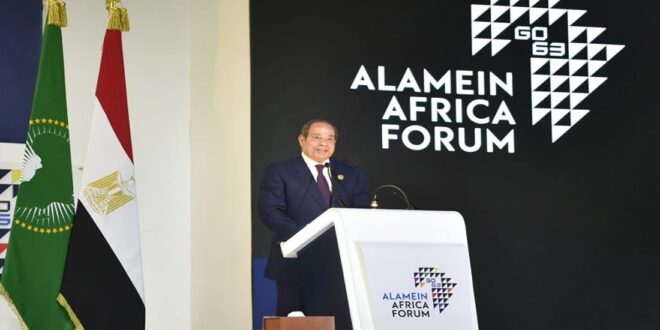
Opening the forum, Egyptian President Abdel Fattah al-Sisi underscored that Africa’s commercial viability remains deeply anchored in its private sector, which currently generates over 70 percent of the continent’s gross domestic product. However, al-Sisi highlighted a structural disconnect in how African enterprise operates globally versus locally.
“Around 85 percent of African private-sector transactions are conducted with companies outside the continent,” al-Sisi noted, stressing that the forum was designed to break down regulatory and transactional barriers so firms can identify opportunities closer to home and construct robust cross-border partnerships.
Echoing this outlook, Mahmoud Ali Youssouf, chairperson of the African Union Commission, reported measurable progress in regional integration while emphasizing the considerable runway remaining.
“In 2024, intra-African trade reached $220 billion, accounting for 14.4 percent of our continent’s trade,” Youssouf informed delegates. Despite a 12.4 percent growth rebound in intra-African trade following a 5.9 percent contraction the previous year, Youssouf made clear that current volumes fall short of the continent’s structural capacity, adding simply that “Africa can do much better.”
Mandated by the African Union to operate as a biennial platform, the summit focuses on unlocking capital across key growth verticals, including infrastructure, agricultural value chains, healthcare, mining, technology, and renewable energy.
For host nation Egypt, the event underscores a deliberate geopolitical pivot southward. Cairo is increasingly looking past its historical Mediterranean and Middle Eastern focal points to expand its economic footprint across Sub-Saharan Africa a region where global players like China and Gulf entities, particularly the United Arab Emirates, have aggressively scaled up investments. Egyptian foreign direct investment on the continent is currently estimated at approximately $14 billion, anchored by major infrastructure commitments such as Tanzania’s $3 billion Julius Nyerere Hydropower Project.
The economic push also unfolds against a delicate diplomatic backdrop. Cairo continues to seek broader continental backing regarding the Grand Ethiopian Renaissance Dam. While Addis Ababa considers the dam crucial for regional energy security and industrial expansion, Egypt maintains that its operational parameters must be bound by a legal agreement to safeguard downstream Nile water flows.